Insights  /  Development & Policy
New York City Zoning · 2024 Initiative

City
of Yes

A structural shift in NYC zoning that is quietly changing how housing gets built — and who gets to build it.

CategoryDevelopment Policy
ByChristofer Holland
Reading Time8 min

Not to be confused with Brooklyn's House of Yes — though both involve transformation in their own way — "City of Yes" is one of the most important structural shifts happening in New York City real estate right now. It's not loud, it's not headline-driven, and it's not being explained clearly to the average buyer or seller. But underneath the surface, it is changing how housing gets built, where it gets built, and — critically — how easily it gets built.

Filed Under Development Policy Zoning NYC Housing

Led by the New York City Department of City Planning, the initiative is designed to remove outdated zoning constraints and introduce flexibility into a system that has historically made development slow, uncertain, and expensive. The headline version is "more housing." The reality is more precise: the city is lowering the friction required to create that housing.

For decades, many projects in New York required going through ULURP — the Uniform Land Use Review Procedure — a multi-step public approval process involving Community Boards, the Borough President, the City Planning Commission, and ultimately the City Council. That process introduces time, uncertainty, and what developers refer to as entitlement risk — the possibility that a project gets delayed, reshaped, or rejected altogether before it ever breaks ground.

What "City of Yes" does, in many cases, is remove that layer entirely.

By updating zoning rules — expanding allowable uses, increasing density thresholds, reducing parking requirements, and enabling more flexible building configurations — the city is shifting certain types of development from discretionary approval into as-of-right. That means if a project complies with zoning, it can proceed directly through the Department of Buildings without political review.


This distinction is not academic — it's financial. As-of-right development carries significantly lower entitlement risk, which makes projects easier to finance, faster to execute, and more likely to actually happen. ULURP, by contrast, introduces a level of unpredictability that can stall or kill deals outright. In that sense, "City of Yes" is less about changing what's possible and more about changing what's practical.
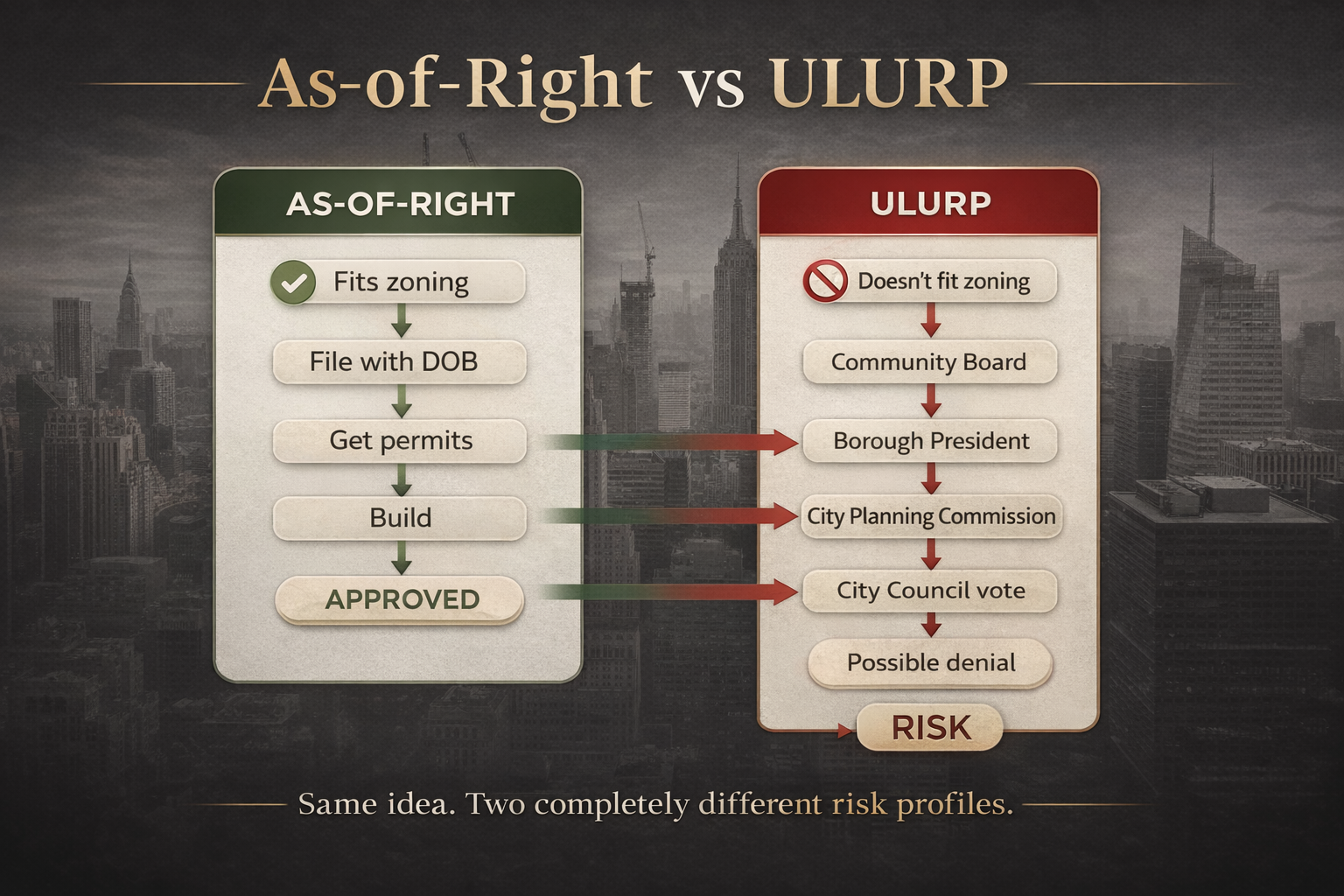
Process Comparison · City of Yes

As-of-Right vs. ULURP

As-of-Right vs ULURP process comparison

Several areas across New York City have already been rezoned — or are in final stages — to allow for high-density, as-of-right residential development, largely driven by the "City of Yes for Housing Opportunity" initiative.

Midtown South
MSMX
~10,000 new homes

42 blocks converting from manufacturing to high-density mixed-use. One of the largest rezonings in decades with significantly increased allowable FAR.

Long Island City
OneLIC
~14,700 new homes

54 blocks rezoned — the largest neighborhood-specific rezoning in 25 years. Approved November 2025. Over 4,350 permanently affordable units required under Mandatory Inclusionary Housing.

Atlantic Avenue
Brooklyn
~4,600 new homes

21 blocks in Crown Heights and Bed-Stuy converted from light manufacturing to mixed-use. Approved May 2025. Transit-connected, previously restricted from housing entirely.

East Bronx
Metro-North
~7,000 new homes

Infrastructure-linked rezoning aligned directly with new Metro-North access points. Ties transit investment to housing growth explicitly.

Jewel Streets
Brooklyn / Queens
~5,000 homes planned

A 12-block neighborhood straddling East New York and Lindenwood. City-owned 17-acre site targeted for 1,400 affordable homes; rezoning expected to unlock 3,600 more. ULURP process beginning 2026.

For buyers, this means new types of inventory will begin to appear in areas that historically had limited options. For sellers, it introduces a new variable — future development — that can impact pricing in ways that aren't always obvious at the moment of listing. For investors, it creates opportunity where regulatory friction is being reduced before the broader market fully adjusts.

We've seen versions of this before. In the lead-up to the 2021 hotel restrictions, developers rushed to vest projects before the window closed. What we are seeing now is the opposite dynamic. The door is opening, not closing — and those paying attention early are the ones positioned to benefit.

The bottom line is simple: "City of Yes" is not a trend. It's infrastructure. It rewards people who understand process, timing, and risk — not just inventory and comps. And over the next several years, it will quietly reshape the physical and financial landscape of New York City real estate.

The question is whether you see it while it's happening — or only after it's already priced in.

Work With Christofer

Buying in a market that's actively changing requires a different kind of preparation.

I work with buyers who want to understand what they're buying — not just what's available. Start with a conversation.

Book a Buyer Orientation Call